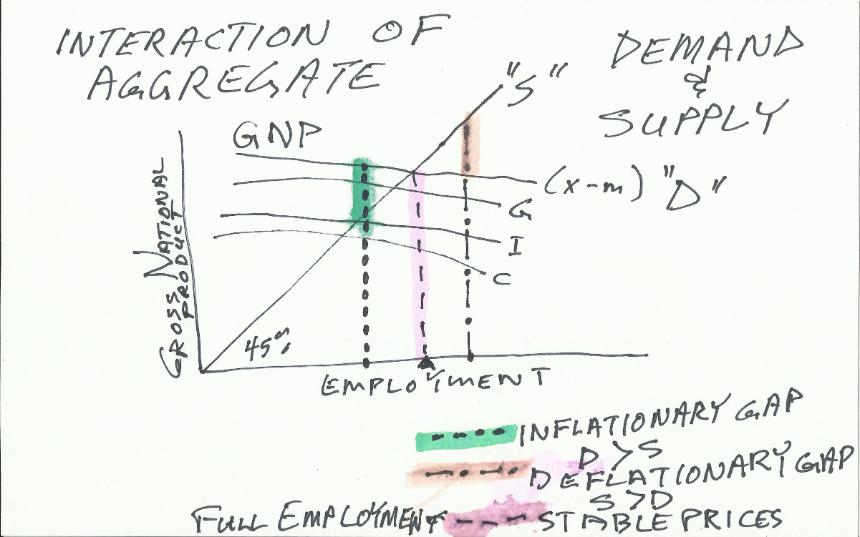
When I read Keynes there seems to be two streams of thought that occassionally intertwine with one another but have their own identities and process.  They have lives of their own and are clearly distinguishable the one from the other.

The one that has gotten the Lions's share of attention in academia and published tomes in and out of academia over the decades since The General Theory was penned, focuses on mainipulating the Aggregate Demand/Aggregate Supply functions in the hope of bringing employment to its "full" level and the most efficient level of the economy's functioning avoiding inflationary and deflationary "gaps" forming between the two aggregate functions at the level of employment permitted by placement  along the x axis.  The chart above eludes to this mechanism.

This "Other Side of Keynes" was touched on in the 1996 webinar on the Post Keynesian Thought website that is reproduced with some embelishment here on the "Home" page.  To reiterate this already used quote is helpfull:

"The outstanding faults of the economic society in which we live are its failure to provide full employment and its arbitrary and inequitable distribution of wealth and incomes."John Maynard Keynes, The General Theory of Employment, Interest andMoney_ Chapter 24 part I

One of the features of this schema that mitigates against an integration of Keynes' two sides is the fact that the "x" axis is in labour units

This may not be at all surprising in a system that considers all labour essentially the same permitting to define an axis of a graph in homogeneous labour units "But" by doing so any use of the analysis is rendered feable at best and dangerously corupt at worst and any policy derived from it is very questionable most likely leading to the kind of mess global economies see themselves in today.

The reason for this cautious approach is the fact that there is no differentiation between labour units.  Full employment of labour making an average of $10 dollars an hour per labour unit and the same amopunt of labour making an average of $20 an hour clearly will produce significantly different aggregates of income.

Since the Aggregate Income differs in these two cases but the Aggregate Supply stays the same, the two amounts will not intersect the "Supply Function" at the same position.

Full Employment of two such groups re a simple example of a situation that necessarily produces a smudge or range of possibilities along the employment axis that renders the analysis less than useful and any conclusions based on this analysis suspect at best.

The areas of theoretical analysis that come to mind include Classical and Keynesian as well as the Neo Classical synthesis.  The Aggregationist understandings of economics are a failled attempt to transport a micro economic mechanism onto the macroeconomic plane. It doesn't work.


This free website was made using Yola.

No HTML skills required. Build your website in minutes.

Go to www.yola.com and sign up today!

Make a free website with Yola